Economic research & public policy
The Cost of Frozen Tax Thresholds
What Minimum-Wage Workers Keep, What Employers Pay and What Government Collects
George Dobritoiu · Robicon Digital Ltd · Figures as at 24 November 2026
The study in one minute
Imagine getting a pay rise every year, but the amount you can earn before paying income tax stays the same. As your wages rise, more of your pay becomes taxable than if that limit had risen with prices.
We wanted to find out how much extra income tax two full-time minimum-wage workers would pay, how much money families actually keep, and what it would cost employers to increase take-home pay instead.
£3,068
Extra income tax for two workers over four completed tax years, compared with a tax-free allowance that rose with inflation.
£4,472
The projected total by April 2027. This is extra income tax, not necessarily money lost after benefits.
The important part: workers still earn about 9.3% more in real take-home pay than in 2021, after allowing for inflation. The freeze has reduced the improvement, not wiped it out.
Read the full report and download the dataThree simple questions
1. How much extra tax have workers paid?
Imagine two adults working full-time at the minimum wage. We compare the income tax they paid with what they would have paid if the tax-free allowance had risen with prices each year.
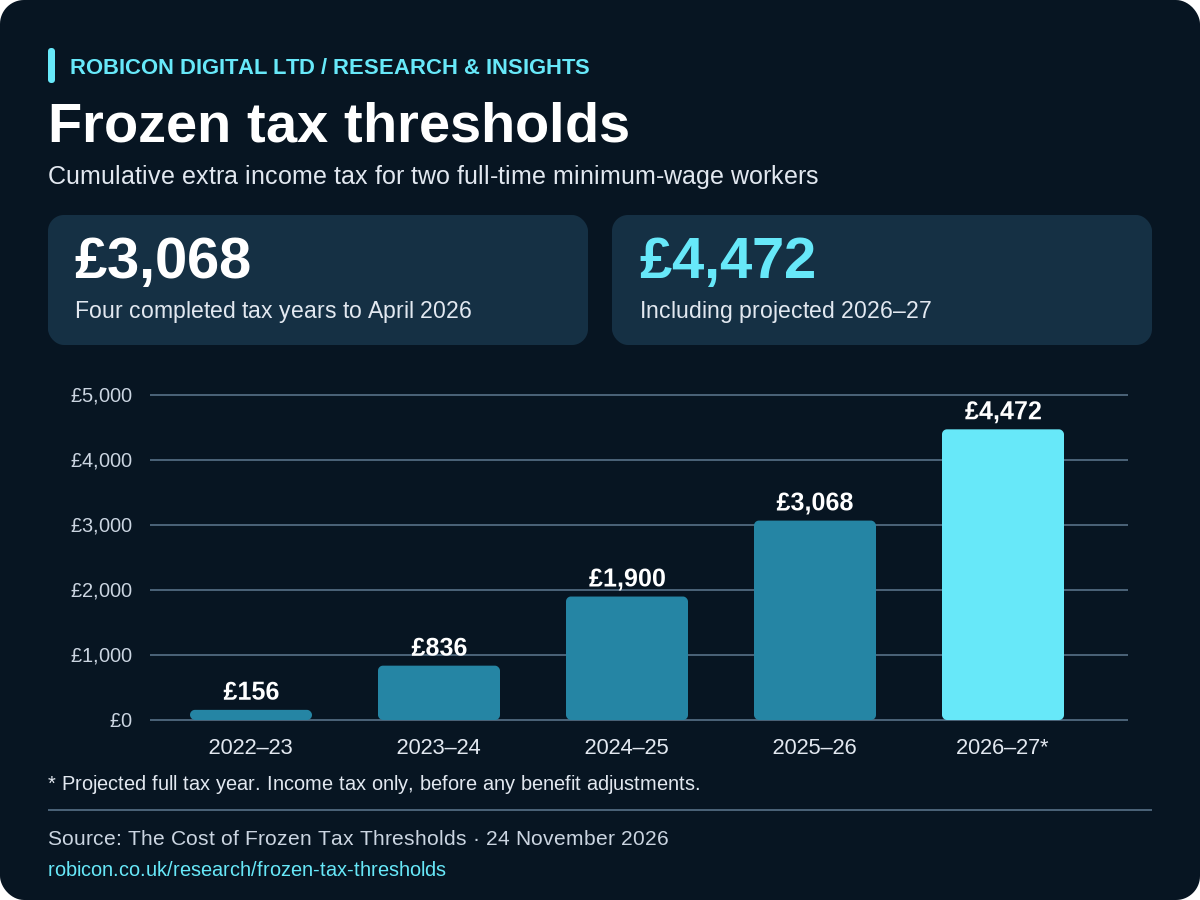
What this means: The bars add up the extra tax over time. By April 2026, the total was £3,068. The last bar includes a projection for the full 2026–27 tax year, taking the total to £4,472.
2. Why are they paying more tax?
The Personal Allowance is the amount most people can earn each year before paying income tax. It has stayed at £12,570 since April 2021. Inflation means that prices have risen while this limit has stayed the same.
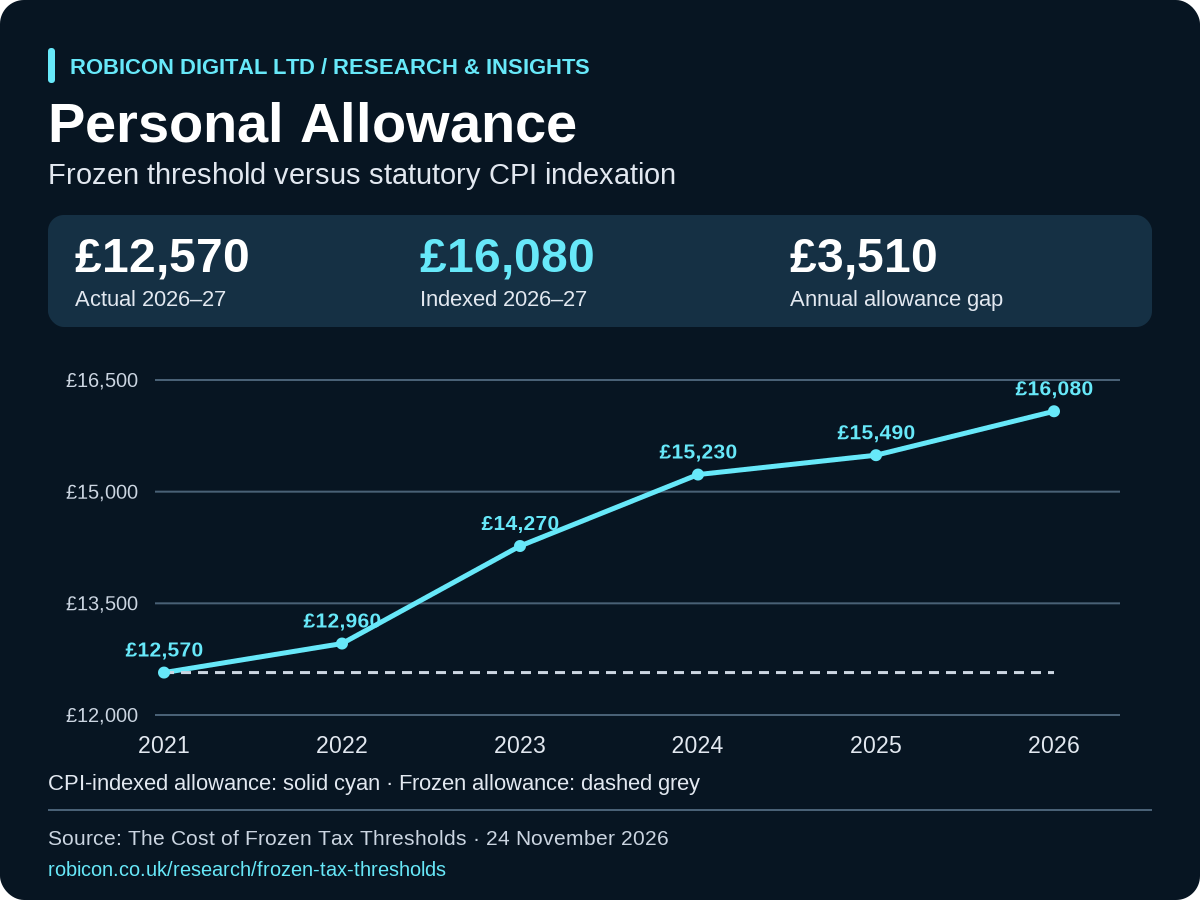
What this means: The flat line shows the actual allowance. The rising line shows what it would have been if it had kept up with inflation. In 2026–27 the difference is £3,510. At a 20% tax rate, that means £702 more income tax per full-time minimum-wage worker over the year.
3. Could workers keep more without costing employers more?
There are two different ways to increase the money a worker takes home: increase their wages, or reduce their income tax. Our example compares two ways of giving a worker £1,372 more each year before any benefit adjustments.
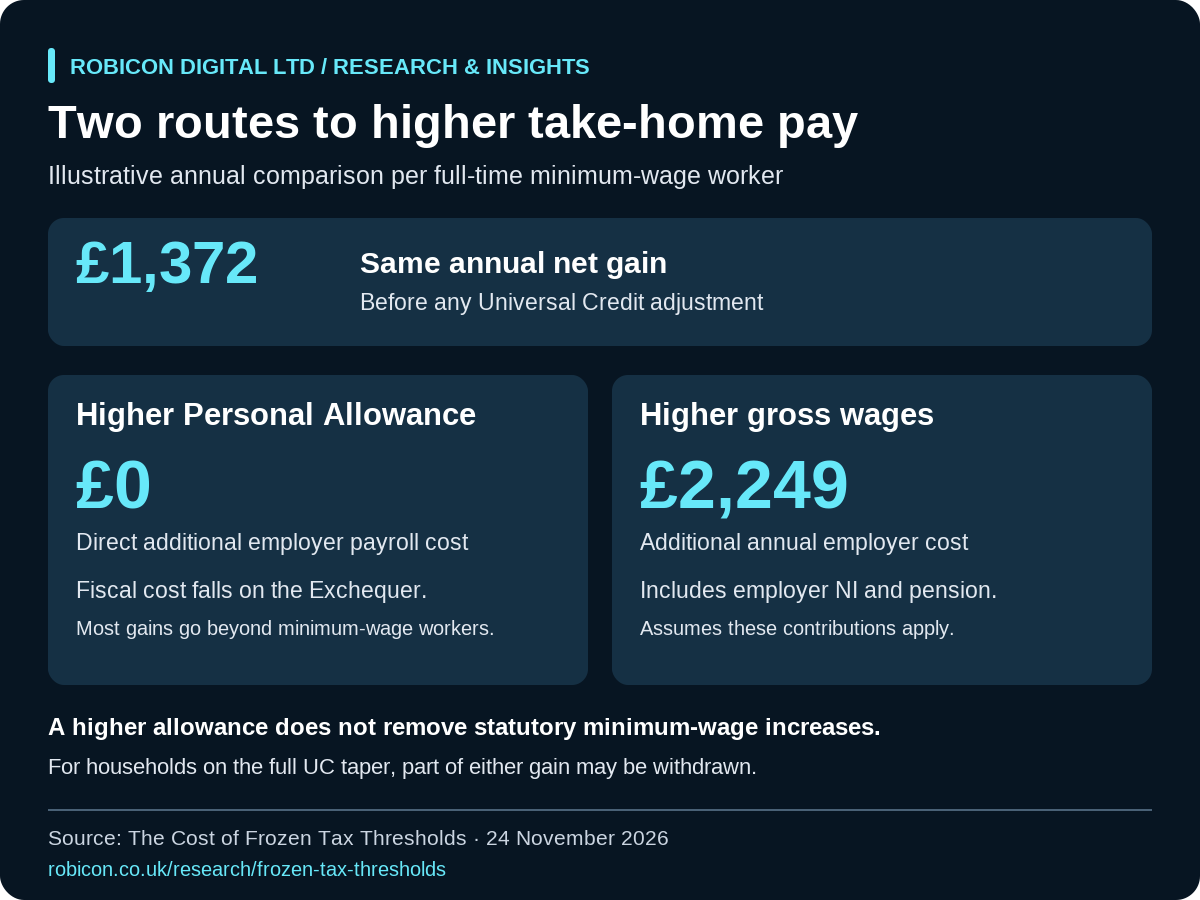
What this means: An equivalent pay rise would cost the employer about £2,249 a year, including employer National Insurance and pension contributions where applicable. A higher tax-free allowance would add nothing directly to payroll costs, but government tax revenue would fall. Neither option removes the legal requirement to raise the minimum wage.
What about families receiving benefits?
Universal Credit is financial support for eligible households. When earnings after tax rise, this support can fall. For a household above its work allowance with enough Universal Credit remaining for the full taper to apply, each £1 of income tax saved increases household income by just 45p.
In our illustrative Wigan example, the two-earner family has no Universal Credit at baseline and keeps the full income tax saving. The study compares five possible policy changes and their costs; it does not recommend a political party or a particular policy.
Download the research and media resources
- Full research paperPDF · Download
- Full research paperWord · Download
- Calculation workbook v1.2Excel · Download
- Journalist summaryPDF · Download
- Press releasePDF · Download
The historical chart, full annual series, correction record and references are included in the full paper.
Methodology and transparency
The model assumes adult minimum-wage employment for 40 hours a week and 52 weeks a year. Income tax figures apply to England, Wales and Northern Ireland; Scotland sets its own bands. The Wigan household examples are illustrative. National fiscal cost estimates for allowance changes are illustrative extrapolations, not official costings. The analysis was AI-assisted and cross-audited using Claude (Anthropic) and ChatGPT (OpenAI); this is not academic peer review.
Independence
Neither Robicon Digital Ltd nor the author has a commercial interest in the policy options discussed, a political party affiliation, or a candidacy for public office.
Research and media enquiries
George Dobritoiu, Director, Robicon Digital Ltd · hello@robicon.co.uk